
100 Mbps vs 200 Mbps vs 300 Mbps Broadband: Which Is Best for Your Home?
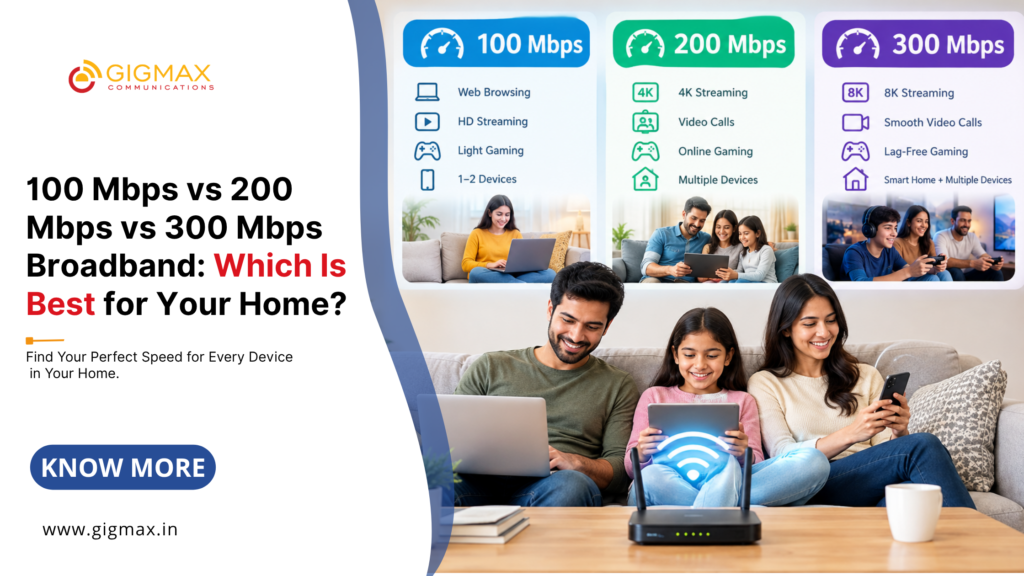
When it comes to enjoying a flawless internet connection at home, selecting the right broadband speed is a crucial decision to make. Whether you’re accessing the internet for your online classes, work, streaming movies, playing games, or social media, choosing the right plan ensures you get the performance and value you’re looking for.
If you are confused about 100 Mbps vs 200 Mbps broadband, or wondering whether you should upgrade to 300 Mbps, understanding the differences can help you make the right decision
Gigmax Communications also provides home fiber broadband services in Faridabad, the packages begin at ₹399 per month. We will discuss 100 Mbps, 200 Mbps, and 300 Mbps broadband speeds in this guide and help you decide on your best broadband speed to use in your house.
100 Mbps vs 200 Mbps vs 300 Mbps: Quick Comparison
| Feature | 100 Mbps | 200 Mbps | 300 Mbps |
|---|---|---|---|
| Internet bandwidth | Up to 100 Mbps | Up to 200 Mbps | Up to 300 Mbps |
| Everyday browsing | Excellent | Excellent | Excellent |
| HD video streaming | Suitable | Suitable | Suitable |
| Multiple 4K streams | Depends on usage | More capacity | Greater capacity |
| Work from home | Suitable for most users | Better for heavier usage | Ideal for bandwidth-heavy households |
| Large downloads | Good | Faster | Faster still, under comparable conditions |
| Multiple active users | Light to moderate usage | Moderate to heavy usage | Heavy simultaneous usage |
| Best for | Individuals and small families | Families with several active users | Larger or high-usage households |
Actual performance depends on your router, connected devices, network conditions, and the applications being used.
What Is 100 Mbps Broadband?
A 100 Mbps internet connection is good enough for daily internet usage. It can use to surf the web, use social media, do online classes, video calls or streaming in HD when the connection and WiFi equipment work well.
Who should choose 100 Mbps?
- Moderate Internet usage by small families.
- Students who are taking on-line courses.
- Users who are viewing websites and watching videos.
- Individuals who require a budget-friendly home WiFi.
- People who want an affordable home WiFi connection.
If you mainly use the internet for regular daily activities, 100 Mbps may provide sufficient bandwidth without requiring you to pay for a faster plan.
Best choice: Users who need reliable internet for everyday browsing, entertainment, and work.
What Is 200 Mbps Broadband?
A 200 Mbps speed connection will have twice the theoretical bandwidth of a 100 Mbps speed connection. It may be suitable if several members of a family are logging on to the internet at the same time.
One person can be in a video call, one person can be watching an online movie and another person can be downloading files, etc. These activities can be implemented together with the additional bandwidth.
Who should choose 200 Mbps?
- Families with several regular internet users.
- Professionals who frequently work from home.
- Households with multiple active streaming devices.
- Students downloading large study files.
- Users who regularly perform several online activities simultaneously.
Best choice: Families that need additional bandwidth for work, entertainment, and everyday internet use across several devices.
What Is 300 Mbps Broadband?
A 300 Mbps broadband connection will have three times as much bandwidth as a 100 Mbps broadband connection, and 50% of the bandwidth of a 200 Mbps broadband connection.
Consider if multiple bandwidth-hungry applications are used simultaneously in your household. This extra capacity can be useful for large downloads, several high-resolution streams, cloud-based work, and gaming downloads.
Who should choose 300 Mbps?
- Larger households with several active users.
- Families streaming high-resolution content on multiple screens.
- Users who frequently download large games or files.
- Professionals handling large file transfers and cloud applications.
- Homes where work, study, and entertainment happen simultaneously.
Best choice: High-usage households that want additional bandwidth for multiple demanding activities.
A 300 Mbps connection will not automatically improve gaming latency, WiFi coverage, or video-call quality if the actual problem is caused by a weak signal, router limitations, or network latency.
100 Mbps vs. 200 Mbps vs. 300 Mbps by Internet Activity
| Online Activity | Suggested Speed |
|---|---|
| Browsing and social media | 100 Mbps |
| Online shopping and email | 100 Mbps |
| HD video streaming | 100 Mbps |
| Online classes and video calls | 100 Mbps |
| Streaming while working from home | 200 Mbps |
| Multiple simultaneous video streams | 200 Mbps or 300 Mbps |
| Large downloads while others use WiFi | 200 Mbps or 300 Mbps |
| Heavy internet usage across many devices | 300 Mbps |
The following are general recommendations. This will vary depending on number of users and the bandwidth of each activity.
How Many Devices Can 100 Mbps, 200 Mbps, and 300 Mbps Support?
The number of devices that can be connected to a broadband speed does not apply to everyone. Using a smartphone to look at social media won’t consume as much bandwidth as downloading a big game on a computer.
But the following examples can help you make your selection:
- 100 Mbps: Suitable for several connected devices with light or moderate simultaneous usage.
- 200 Mbps: Better suited to households where several devices actively stream, work, study, or download files.
- 300 Mbps: Provides more bandwidth for households with many active users and demanding online activities.
Remember that the router’s supported device capacity and WiFi coverage also affect the experience.
Does 300 Mbps Mean Three Times Faster Downloads?
A 300 Mbps connection offers three times the theoretical bandwidth of a 100 Mbps connection. Under comparable conditions, a large download that takes ten minutes on a fully utilised 100 Mbps connection could take approximately three minutes and twenty seconds on a fully utilised 300 Mbps connection.
This is an illustration, not a guaranteed download time. The actual result depends on server speed, network congestion, WiFi performance, and device limitations.
For reference:
- 100 Mbps = approximately 12.5 MB/s.
- 200 Mbps = approximately 25 MB/s.
- 300 Mbps = approximately 37.5 MB/s.
These are theoretical maximum transfer rates before overhead and other real-world limitations. Mbps means megabits per second, while MB/s means megabytes per second.
How to Choose the Right Broadband Speed
Before you decide on 100 Mbps, 200 Mbps, or 300 Mbps, there are five factors that you should take into consideration
1. Number of active users: Several people using bandwidth-intensive applications simultaneously may benefit from a faster plan.
2. Internet activities: Browsing requires relatively little bandwidth compared with large downloads and multiple high-resolution streams.
3. Monthly budget: Select a plan that offers enough speed for your budget.
4. Router performance: A suitable router and good placement help you get better results from your connection.
5. Reliability and customer support: Take into account connection reliability, conditions in the plan, installation terms, and local customer support.
Get Home Fiber Broadband with Gigmax Communications
Looking for a home broadband connection in Faridabad? Gigmax Communications provides fiber broadband options with plans starting at ₹399*/month.
Whether you need 100 Mbps for everyday internet use, 200 Mbps for a busy family, or 300 Mbps for heavier simultaneous usage, choose a plan according to your household’s needs and available options.
Gigmax broadband benefits include:
- Affordable home broadband plans.
- Unlimited data options, subject to plan terms.
- Free installation, subject to applicable conditions.
- Free WiFi router, subject to applicable terms.
- Local customer support.
Gigmax serves selected areas of Faridabad, including SGM Nagar, Greenfield Colony, Badkhal Colony, and Old Faridabad. Contact Gigmax to confirm service availability and the plans offered at your address.
Final Thought: Choose 100 Mbps for everyday browsing and moderate household usage, 200 Mbps for multiple active users, or 300 Mbps if your household regularly performs several bandwidth-intensive activities at once. The right broadband plan is the one that meets your internet requirements and budget.
Frequently Asked Questions
Should I get 100 Mbps or 200 Mbps?
Choose 100 Mbps if you mainly use the internet for browsing, social media, HD streaming, online classes, video calls, and regular work from home. It is generally suitable for a small household with moderate internet usage.
Choose 200 Mbps if several people regularly use the internet at the same time for streaming, work, online classes, gaming, or large downloads. The additional bandwidth can provide more capacity for simultaneous activities.
Which is better, 100 Mbps or 300 Mbps?
Both can be good choices depending on your internet usage. 100 Mbps is suitable for everyday browsing, streaming, video calls, and moderate household usage. 300 Mbps is better suited to households with several active users, multiple high-resolution streams, large downloads, and other bandwidth-intensive activities.
If your household has light-to-moderate usage, 100 Mbps can be more economical. If several people frequently use the internet simultaneously, 300 Mbps provides considerably more bandwidth.
Is 200 Mbps fast for Netflix?
Yes, 200 Mbps is more than enough bandwidth for Netflix streaming for most homes. It can comfortably support high-quality streaming while leaving bandwidth available for other household activities.
The actual experience also depends on your WiFi connection, router, connected devices, and the number of people using the network at the same time.
Is 200 Mbps good for home?
Yes, 200 Mbps is a good home broadband speed for many families. It provides enough bandwidth for activities such as streaming, video calls, online classes, work from home, browsing, gaming, and downloading files.
If multiple family members are using several devices simultaneously, 200 Mbps can provide a comfortable balance between performance and cost. For households with lighter internet usage, 100 Mbps may be sufficient, while heavy-use households may benefit from 300 Mbps.