
Internet connectivity is crucial for any kind of modern business organization. Cloud applications, online transactions, video conferencing, communication, and data sharing are essential to corporate offices, hospitals, schools, retail stores, and expanding businesses that rely on internet connectivity. Productivity and customer experience can be impacted by a network outage, even if it lasts only a few seconds.
This is why businesses should look beyond internet speed when selecting a connectivity solution. An Internet Leased Line SLA helps define the service quality, uptime expectations, technical support commitments, and responsibilities agreed upon between a business and its internet service provider.
Knowing an SLA can assist organizations in assessing providers, comparing service pledges, and deciding which connection to use is correct for their operational needs.
What Is an Internet Leased Line SLA?
An Internet Leased Line SLA, or Service Level Agreement, is a contractual agreement detailing the performance and support levels expected from the Internet leased line service provider.
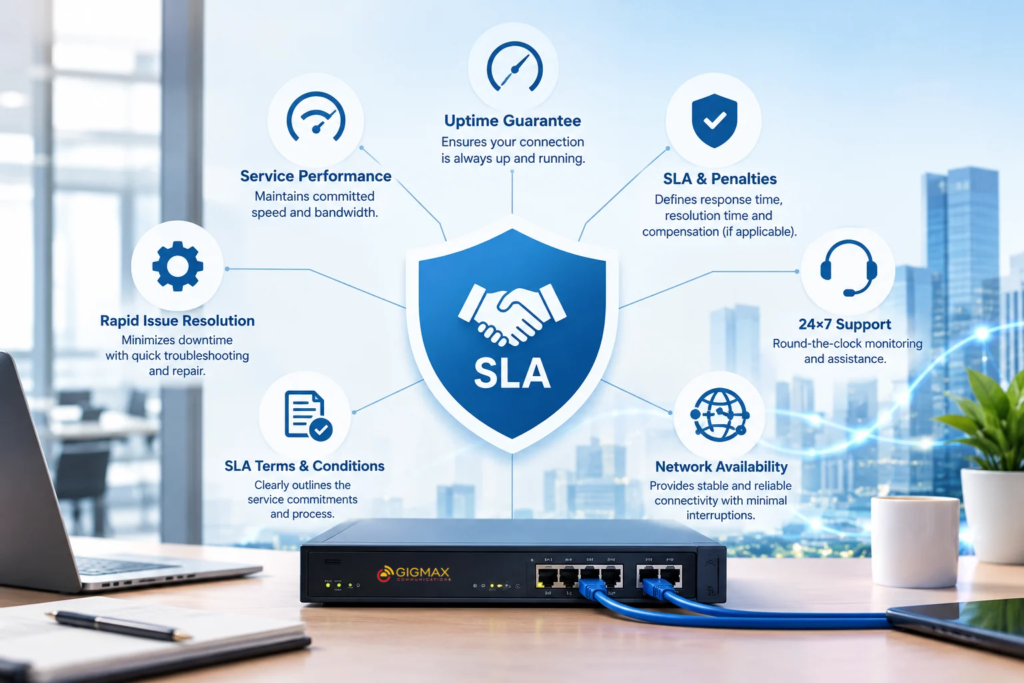
It generally outlines what is expected when using the network, the action that will be taken when a fault is encountered, what will be done to restore the services, the bandwidth commitment, and what will be done if the specified bandwidth is not met.
An SLA can help businesses get such clarity about what to expect from their ISP, especially when their business requires round-the-clock connectivity.
For instance, a business could need a specified uptime goal, a particular technical support reply time, and a documented process for reporting and fixing network issues. These terms can be included in the service agreement, depending on the provider’s offering.
Why Is an SLA for Business Internet Connection Important?
An SLA for Business Internet Connection is particularly important when internet connectivity supports critical business activities.
Here are some key reasons why businesses should review SLA terms before choosing a provider.
1. Clear Uptime Expectations
An SLA can define a percentage of time that a connection is supposed to be up. This enables businesses to determine the provider’s availability commitment and assess if it fits their operation.
2. Defined Technical Support
There must be a clear procedure for businesses to report connectivity issues. An SLA can set out how the support is available, set response times, define escalation procedures, and set fault resolution targets.
These facts are especially worth considering for any companies that can’t afford a lengthy disruption.
3. Better Business Planning
If performance expectations and support procedures are documented, IT teams can plan their operations more effectively. They can also set up their own procedures for fault reporting and communication with the service provider.
4. Greater Accountability
An agreement is in writing that outlines what each party will do. It can also outline “service credits” or other remedies if the provider does not comply with applicable commitments, as may be prescribed by contract.
These conditions should be read carefully and not taken as a given that all SLA’s contain the same guarantees.
What Does a Leased Line SLA Usually Cover?
Before signing a service agreement, businesses should understand the main performance metrics and service conditions.
Availability and Uptime
Uptime is the amount of time an internet connection is up and running over a given time frame. The higher the uptime percentage, the less downtime that is allowed.
For instance, if you have a 99.9% uptime guarantee, that means you will experience about 8.76 hours of downtime per 365-day period. The actual SLA calculation can vary based on exclusions, measurement techniques, and the contract period.
Bandwidth and Speed
The SLA should specify the bandwidth being delivered and performance guarantees. A leased line typically provides symmetrical upload and download speeds, which is beneficial for businesses that need to upload and download data, such as cloud backups, video conferencing, data transfers, and more.
Businesses should check the bandwidth they have committed to and also if there’s any restriction or measurement condition.
Latency and Network Performance
Latency is the time it takes data to get between network endpoints. In video conferencing, voice communication, remote applications, and real-time systems in businesses, it’s crucial that they possess lower latency.
If performance is important, it’s essential for businesses to ensure that the agreement specifies measurable latency, packet loss, or jitter expectations.
Fault Response and Resolution Time
An SLA may distinguish between the time taken to acknowledge a complaint and the time required to restore service.
For this reason, businesses should check the provider’s support hours, escalation process, fault reporting method, and target restoration time. A response-time commitment does not necessarily mean the issue will be resolved within the same period.
What Is a Leased Line Uptime Guarantee?
A leased line uptime guarantee is a contractual commitment describing the expected availability of the internet connection during a defined measurement period.
However, businesses should not compare uptime percentages alone. The practical value of an uptime commitment also depends on how downtime is measured, which interruptions are excluded, and what happens if the target is missed.
For example, a company operating an online booking system may need a stronger availability commitment than a small office that mainly uses email and basic browsing.
When reviewing uptime guarantees, ask the provider:
- What uptime percentage is included in the agreement?
- How is availability measured?
- Are planned maintenance periods excluded?
- What is the process for reporting outages?
- Are service credits or other remedies available if the commitment is breached?
Understanding these details helps businesses make a more informed decision.
Why Choose a Dedicated Internet Connection for Business?

A Dedicated Internet Connection for Business is designed for organizations that require dependable connectivity for their daily operations.
Unlike typical shared broadband services, a business leased line generally provides dedicated bandwidth for the customer, according to the contracted service design. It is often suitable for businesses with demanding upload requirements, multiple users, cloud-based systems, or communication platforms.
Key benefits can include:
- Consistent bandwidth: Supports business applications and data transfers.
- Symmetrical speeds: Helps teams upload and download large files efficiently.
- Predictable support: Contractual escalation and restoration procedures can help manage network faults.
- Business continuity: A suitable SLA and backup connectivity plan can reduce the operational impact of outages.
- Scalability: Bandwidth can be upgraded as business requirements grow, subject to availability and the provider’s terms.
The right solution depends on the number of users, application requirements, network design, budget, and the consequences of downtime.
How to Choose the Right Internet Leased Line Provider
Selecting an Internet Leased Line Provider involves more than comparing monthly prices or advertised speeds. Businesses should evaluate the provider’s service commitments and ability to support their operational needs.
1. Check Network Availability
Confirm that the provider can deliver the required connection at your office or commercial premises. Installation timelines may depend on fibre availability, the last-mile network, and site feasibility.
2. Compare SLA Commitments
Review uptime targets, support availability, response times, restoration targets, and contractual remedies. Compare equivalent terms rather than relying on headline claims.
3. Understand Your Bandwidth Requirements
Consider the number of employees, simultaneous video calls, cloud applications, file transfers, online transactions, and future expansion plans.
4. Review Technical Support
Check how to raise a fault, whether escalation is available outside standard working hours, and how the provider communicates service updates.
5. Ask About Backup Connectivity
For critical operations, consider a secondary connection or another appropriate redundancy arrangement. A backup link can help maintain essential activities if the primary connection fails.
6. Read the Contract Carefully
Review installation charges, recurring fees, contract duration, renewal conditions, maintenance exclusions, and any applicable service-credit provisions before signing.
How Gigmax Supports Business Connectivity
Gigmax Communications provides business connectivity solutions, including leased line services for organizations that need dependable internet access.
Businesses evaluating a leased line can discuss their location, bandwidth requirements, application usage, and support expectations with Gigmax to identify a suitable solution.
Whether you operate a corporate office, hospital, educational institution, retail business, or multi-location organization, assessing your connectivity needs and reviewing the applicable service terms can help you make a better-informed decision.
Frequently Asked Questions
What Is SLA in the Internet?
SLA stands for Service Level Agreement. It is an agreement between an internet service provider and a customer that defines service expectations, including network uptime, performance, technical support, and fault resolution. For businesses using an Internet Leased Line SLA, these terms help clarify the provider’s commitments and the procedures to follow if service issues occur.
What Is an SLA for an Internet Service Provider?
An SLA for an internet service provider specifies the service standards and support commitments offered to customers. It may cover uptime guarantees, bandwidth, latency, complaint response times, fault restoration targets, and service credits for failing to meet agreed conditions. Businesses should review the actual SLA to understand the coverage, exclusions, and remedies included in their contract.
How Much Does a 100 Mbps Leased Line Cost?
The cost of a 100 Mbps leased line in India depends on the service provider, installation requirements, location, contract duration, bandwidth commitment, and SLA level. Enterprise-grade connections can cost significantly more than residential broadband because they typically include dedicated bandwidth and business-oriented service commitments. For an accurate quotation, businesses should request a location-specific estimate that includes monthly rental, installation charges, applicable taxes, and any additional equipment costs.
What Is a Leased Line in Internet?
An internet leased line is a dedicated internet connection designed primarily for businesses that require consistent bandwidth and reliable connectivity. Unlike typical residential broadband, a leased line generally provides dedicated bandwidth and often offers symmetrical upload and download speeds. It is suitable for corporate offices, hospitals, schools, retail stores, and organisations that depend on cloud applications, video conferencing, online transactions, and data transfers.
Conclusion
A well-defined SLA helps businesses understand the performance and support commitments associated with their internet connection. By evaluating uptime, bandwidth, latency, fault response, and restoration procedures, organisations can make more informed decisions about their connectivity requirements.
Before selecting an Internet Leased Line Provider, review the actual agreement and ensure that its commitments match your business needs. For organisations looking for business connectivity options, Gigmax Communications can help assess requirements and discuss suitable leased line solutions based on service availability. Contact Gigmax Communications to explore business internet connectivity options.
| Explore Leased Line Plans in your city |
| Leased Line Plans in Faridabad |
| Leased Line Plans in Delhi |
| Leased Line Plans in Noida |
| Leased Line Plans in Gurgaon |