Leased Line Connectivity: What Is a Leased Line, How It Works, and Why Businesses Need Dedicated Internet?
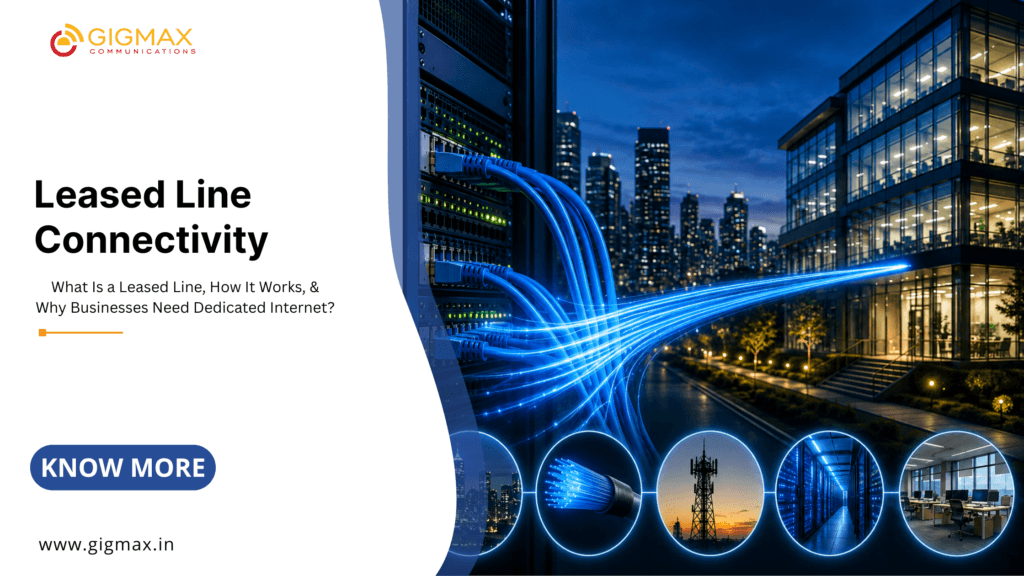
A standard broadband connection might not always suffice for businesses that require reliable, high-speed, and stable internet connections. Businesses that rely on cloud applications and video conferencing, online transactions, remote access, large file transfers, and business-critical applications may require a more reliable solution. This is where leased line connectivity can make a major difference.
A leased line provides a dedicated internet connection for business use. Unlike shared broadband connections, a dedicated leased line provides reliable, consistent connectivity, business-class reliability, and symmetric upload and download speeds. This is especially helpful for businesses, enterprises, banks, IT firms, schools, call centers, and other businesses that rely on a continual internet connection.
In this guide, we explain what is a leased line, how does a leased line work, and the benefits of choosing a leased line internet connection for business operations.
What Is a Leased Line?
A leased line is a dedicated telecommunications circuit between a business site and an internet service provider’s network. Unlike many traditional broadband connections, the connection is not shared with other users and is dedicated to the customer.
A leased line can be used for business Internet traffic and is typically configured to support a consistent performance. Depending on the need, businesses can choose different bandwidth capacities like 50 Mbps, 100 Mbps, 200 Mbps, 500 Mbps, 1 Gbps, or more.
One of the important characteristics of leased line connectivity is symmetrical bandwidth. For instance, if you have a 100 Mbps leased line, you can expect approximately 100 Mbps upload and download speeds, depending on the details of the service and network conditions.
How Does a Leased Line Work?
Understanding how does a leased line work is relatively simple.
The first step is that the ISP creates a specific connection between their network and the customer’s business office. The use of fiber-optic infrastructure is common due to its ability to provide high bandwidth and data transmission reliability.
Appropriate network equipment is employed to connect the customer’s office to the provider’s network. This exclusive link is used to carry traffic from the business to the Internet services, cloud services, business applications, business websites, and other online resources.
A business leased line is not a normal shared broadband connection but is based on committed service capacity and business-level services. It can also come with additional services like static IP addresses, monitoring, service-level agreements (SLAs), and technical support, depending on the provider and package.
Leased Line Internet Connection vs Broadband
A standard broadband service is usually created to be used with residence or small business Internet connections. Bandwidth and network capacity may be shared between a number of customers.
A leased-line internet connection, on the other hand, is designed for organizations that require predictable and business-grade connectivity.
Here are some key differences:
| Feature | Broadband | Leased Line |
|---|---|---|
| Connection | Generally shared | Dedicated business connection |
| Upload speed | Often lower than download | Typically symmetrical |
| Reliability | Good for regular use | Designed for business-critical use |
| Static IP | May be optional/unavailable | Commonly available |
| SLA | Usually limited | Business SLA may be offered. |
| Business applications | Suitable for basic requirements | Suitable for demanding workloads |
| Cost | Lower | Higher |
For businesses where internet downtime can directly affect productivity or revenue, the additional cost of leased line connectivity may be justified.
What Is a Dedicated Leased Line?

A dedicated leased line is a business internet connection provisioned specifically for an organization. The service aims to deliver a consistent bandwidth and reliable connection from the customer premises to the service provider’s network.
Dedicated leased lines are typically employed by companies that rely on the internet extensively. For instance, an IT firm could demand a particular connection for cloud development, or a financial establishment might need a steady connection for online exchanges and secure applications.
Specific connectivity can also be utilized for VPN, remote office connection, cloud connectivity, video conferencing, VoIP, surveillance, and data-intensive applications.
Benefits of Leased Line Connectivity
1. Consistent Internet Performance
Predictable performance is one of the main benefits of leased line connectivity. Businesses can base their network needs on a predetermined bandwidth.
2. Symmetrical Upload and Download Speeds
A number of leased line packages offer symmetrical bandwidth. This becomes particularly useful for companies that regularly upload large files, upload cloud applications, host services, or have video conferences.
3. Better Business Reliability
Internet stability is key for businesses with online systems. A leased line is engineered to be a business-class service and may offer enhanced support and service levels compared to standard broadband.
4. Static IP Address
There are cases when businesses need a static IP address for a variety of applications like remote access, VPN, servers, CCTV systems, and many more. Availability of static IP is determined by the provider and service package.
5. Better Support
There may also be dedicated technical support and defined response or restoration commitments through a SLA for business leased line services.
6. Supports Cloud Applications
Cloud platforms are the foundation of the modern business. They allow accounting, CRM, storage, communication, collaboration and enterprise applications. Employees can have consistent access to these services through reliable leased line connectivity.
7. Suitable for Multiple Users
Higher capacity dedicated internet connections are ideal for organizations with many employees and devices. The right bandwidth depends on the number of users and the applications in use.
Who Should Consider a Leased Line?
A leased line can be useful for:
- IT and software companies
- Corporate offices
- Banks and financial organizations
- Call centers and BPOs
- Hospitals and healthcare organizations
- Schools and colleges
- Hotels
- Manufacturing companies
- Retail businesses
- Data-driven enterprises
- Organizations using cloud applications
- Businesses with multiple locations
If internet connectivity is critical to daily operations, a leased line can provide a stronger business-grade solution than conventional broadband.
How to Choose the Right Leased Line?
Before purchasing a leased line, businesses should evaluate several factors.
Bandwidth
Estimate number of users, devices, applications, video meetings, cloud services and data transfers. Select bandwidth according to needs today and in the future.
Service-Level Agreement
Check the provider’s SLA, uptime commitment, fault response time, and restoration process.
Static IP
If your business needs VPNs, remote access, servers, or other network applications, ask whether static IP addresses are included.
Fiber Availability
A fiber-based leased line is generally preferred for high-capacity business connectivity. Confirm that the provider can deliver fiber connectivity at your premises.
Technical Support
Reliable technical support is important because even a short internet outage can affect business operations.
Scalability
Choose a provider that can upgrade your bandwidth as your organization grows.
How Much Does a 100 Mbps Leased Line Cost?
The cost of a 100 Mbps leased line is determined by city, location, fiber availability, provider, installation needs, SLA, static IP requirements, contract length, and other service features.
So there is not a national price for a 100 Mbps leased line. Business houses should contact us for a customized quotation after the feasibility check at their premises.
When evaluating providers, organizations need to compare the full service package, not just the monthly price.
Leased Line Connectivity for Growing Businesses
As businesses become increasingly dependent on digital operations, reliable internet connectivity is no longer optional. Cloud software, online meetings, digital payments, remote working, customer support, cybersecurity systems, and data transfers all depend on a stable connection.
A leased line internet connectivity solution can provide the performance and reliability required by organizations with demanding internet requirements.
Before selecting a provider, businesses should compare bandwidth, SLA, static IP availability, installation, support, scalability, and total cost.
Conclusion
Leased line connectivity is a key business internet solution for businesses that require reliable, consistent, and high-performance connectivity. A dedicated leased line with dedicated bandwidth, symmetrical upload and download speeds, static IP options, and business-grade support can help businesses keep their digital operations running smoothly.
If you need a reliable leased line connection for your business, then you should consider Gigmax Communications for your business connectivity needs. Gigmax offers internet solutions for business high-speed connectivity designed to support offices, businesses, cloud apps, video conferencing, telecommuting, and other critical online activities. Get in touch with Gigmax to find out if leased lines are available, what bandwidth options are available, and what the price is for your business location.
Frequently Asked Questions
What is the difference between MPLS and leased lines?
MPLS is a network technology commonly used to connect multiple business locations through a managed private network. A leased line is a dedicated connectivity service between locations or between a business and an ISP network. MPLS is generally useful for connecting multiple offices, while a leased line can provide dedicated internet or point-to-point connectivity. The right option depends on the organization’s network architecture and requirements.
How much does a 100 Mbps leased line cost?
The cost of a 100 Mbps leased line depends on location, provider, fiber feasibility, SLA, static IP requirements, installation, contract duration, and other service conditions. Businesses should request a quotation from the provider after a location feasibility check.
Which is better, leased line or broadband?
It depends on the requirement. Broadband can be suitable for homes and small businesses looking for affordable internet access. A leased line is generally better for businesses that need consistent bandwidth, symmetrical speeds, business support, static IP options, and higher reliability.
Who is the best internet leased line provider in India?
There is no single provider that is best for every business. The right provider depends on service availability at your location, pricing, bandwidth options, SLA, support quality, installation time, and network performance. Businesses should compare multiple providers and select the one that best matches their requirements.