A strong internet connection is essential for businesses to function, connect with customers, use cloud applications, and move critical data. Many people and small businesses can use regular broadband Internet service, but organizations that require reliable Internet access may want a dedicated Internet connection.
Businesses can leverage the leased line benefits to make the right internet solution choice when they need it. Ideal for offices, IT companies, corporate environments, and organizations that require a dependable internet connection, a leased line provides dedicated bandwidth, consistent performance, and business-oriented support.
We will discuss the pros and cons of a leased line, the differences between standard broadband and a leased line, and when businesses should move to a leased line.
What Is a Leased Line Internet Connection?
A leased line is a private internet connection that is rented from a service provider. When compared to a shared broadband, a leased line gives the customer more bandwidth to her use and helps ensure more consistent performance during rush hours.
Symmetrical bandwidth: businesses can opt for symmetrical bandwidth with upload and download speeds equal. This is especially beneficial for video conferencing, cloud storage, data transfers, remote work, or running business applications.
Gigmax Communications is a company that offers Internet connectivity solutions to businesses in selected cities of Delhi NCR. Companies can look into specific connectivity choices depending on their bandwidth, uptime, and bandwidth needs.
7 Major Leased Line Benefits for Businesses
1. Dedicated Bandwidth
One of the primary benefits of leased line connectivity is dedicated bandwidth. Allocated bandwidth can be used concurrently to support businesses without competition from other businesses on the same access connection.
This can help organizations to predict internet performance when employees are using cloud software, holding online meetings, transferring large files, or accessing business applications at the same time.
2. Consistent Internet Performance
The speed of the internet can vary and disrupt key business processes. A dedicated leased line is intended to deliver higher quality service even when there’s a surge in Internet usage throughout busy business hours.
This can be a good thing for offices that require constant connectivity throughout the working day.
3. Equal Upload and Download Speeds
A great number of leased line services feature symmetrical bandwidth. For instance, if one has a 100 Mbps symmetrical connection, they have up to 100 Mbps upload speed and 100 Mbps download speed.
It comes in handy for companies that upload big files often, maintain cloud backups, conduct video conferences, or share data with distant offices.
4. Business-Focused Support and SLA
Business internet requirements often extend beyond speed. Organizations may need defined service commitments, fault response procedures, and technical support.
A leased line service may include a Service Level Agreement (SLA) covering specified availability, fault response, or restoration targets. Businesses should review the actual SLA offered by their provider before selecting a plan.
5. Better Support for Cloud Applications

Numerous businesses are now employing cloud-based accounting solutions, CRM systems, ERP solutions, online storage, and collaboration tools.
Good connectivity enables staff to access these services more regularly. Leased line services can be invaluable if cloud applications form an integral part of the company’s daily business.
6. Reliable Video Conferencing and Remote Work
Inadequate connectivity can result in video calls being frozen, meetings not taking place, and communication taking too long. For companies that rely on video conferencing and communication systems, a leased line may be a more reliable option for bandwidth.
But latency, jitter, packet loss, network setup, and the conference service itself also have an impact on the quality of the call.
7. Improved Business Continuity
When there is a downtime in the internet, it can cause delays in customer service, interruptions in transactions, and impact productivity. Businesses can mitigate connectivity risks with an appropriate SLA and effective technical support.
For organizations that cannot afford to have their internet connection cut off, it may be wise to have a second connection for failover and redundancy.
Advantages and Disadvantages of Leased Lines
Before choosing a dedicated internet connection, businesses should understand both its strengths and limitations.
Advantages of Leased Line
- Dedicated bandwidth: Helps provide more predictable internet performance.
- Symmetrical speeds: Equal upload and download capacity may be available.
- Business continuity: SLA-backed services can define availability and fault-handling commitments.
- Cloud connectivity: Supports regular use of cloud applications and data transfers.
- Video conferencing: Predictable network performance can help improve meeting quality.
- Business scalability: Bandwidth options may be upgraded as requirements grow.
- Professional support: Business-oriented service and escalation procedures may be available.
Disadvantages of Leased Line
- Higher cost: Leased lines generally cost more than standard residential broadband.
- Installation time: Feasibility checks, infrastructure work, and installation can take time.
- Contract commitments: Some services require a minimum contract period.
- Availability limitations: Dedicated connectivity may not be available at every location.
- Technical requirements: Businesses may need suitable routers, firewalls, and network configuration.
- SLA limitations: Service commitments vary by provider and contract; an SLA does not guarantee that outages will never happen.
A leased line is not necessary for every business. Small offices with basic browsing, email, and occasional video meetings may find regular broadband sufficient.
Benefits of Leased Line Over Broadband
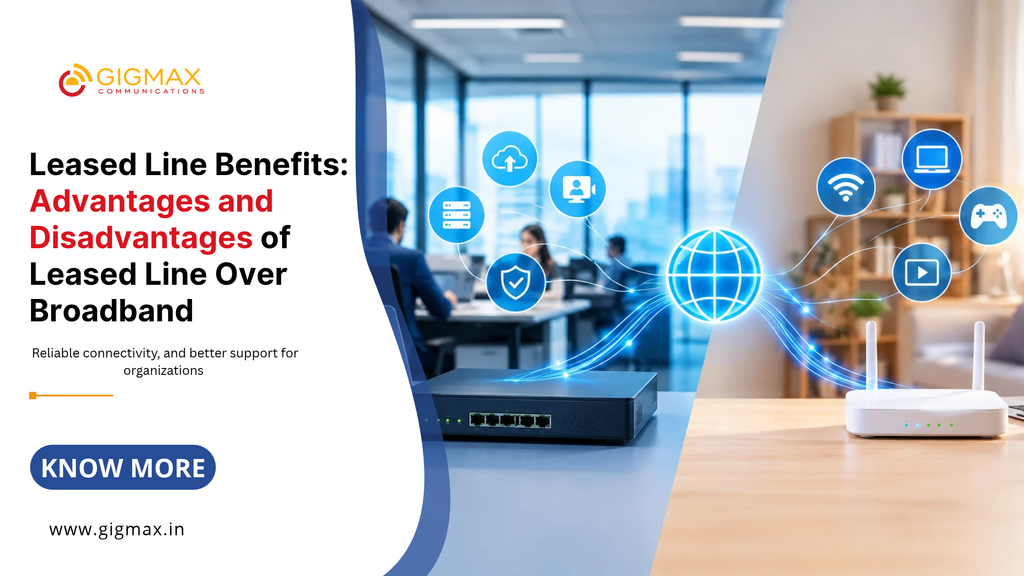
The main difference between a leased line and regular broadband is how bandwidth and service commitments are provided.
| Feature | Leased Line | Regular Broadband |
|---|---|---|
| Bandwidth | Dedicated capacity | Often shared in the access network |
| Speed consistency | Generally more predictable | May fluctuate with network conditions |
| Upload speed | Symmetrical options commonly available | Often lower than download speed |
| SLA | Business SLA may be available. | Often limited or different for residential plans |
| Cost | Generally higher | Generally more affordable |
| Best suited for | Businesses with critical connectivity needs | Homes and businesses with everyday needs |
| Installation | May require a feasibility survey | Often simpler where infrastructure exists |
The benefits of leased line over broadband are most noticeable when a business needs predictable performance, high upload capacity, defined service commitments, or reliable connectivity for essential operations.
However, a leased line does not automatically offer lower latency or better performance for every application. The provider’s network, routing, service design, and connection quality also matter.
Is a Leased Line Better Than Broadband?
The right choice depends on how your organization uses the internet.
Choose a leased line if your business:
- Uses cloud applications throughout the day.
- Transfers large files or performs frequent cloud backups.
- Has multiple employees attending online meetings simultaneously.
- Operates servers, business applications, or important online systems.
- Requires an SLA and defined technical support arrangements.
- Experiences significant productivity losses during internet disruptions.
Choose regular broadband if your requirements mainly involve browsing, email, basic office applications, and occasional video calls, and a business-grade SLA is not essential.
For some organizations, a high-quality broadband connection combined with a separate backup connection may provide a more economical solution.
How to Choose the Right Leased Line Plan

Before selecting a leased line, evaluate these important factors:
- Bandwidth requirements: Estimate the number of users, applications, and simultaneous activities.
- Upload capacity: Consider cloud backups, file transfers, and video conferencing.
- Uptime commitments: Review the SLA, availability target, and exclusions.
- Fault restoration: Check the provider’s response and restoration commitments.
- Network security: Confirm your firewall, access controls, and security requirements.
- Scalability: Choose a service that can accommodate future business growth.
- Total cost: Compare installation charges, monthly fees, contract terms, and equipment costs.
- Local availability: Confirm feasibility at your office address before finalizing the service.
A suitable leased line should match your business requirements rather than simply offer the highest available bandwidth.
Frequently Asked Questions
1. What are the main leased line benefits?
The main benefits include dedicated bandwidth, consistent performance, symmetrical upload and download speeds, business-focused support, and the availability of SLA-backed service commitments.
2. What are the advantages and disadvantages of a leased line?
Advantages include predictable performance, dedicated capacity, and business continuity support. Disadvantages include higher costs, possible installation delays, contract commitments, and limited availability in some locations.
3. Which is better, broadband or leased line?
Broadband is generally better for homes and small offices that need affordable internet for browsing, streaming, email, and everyday work. A leased line is more suitable for businesses that require dedicated bandwidth, symmetrical upload and download speeds, predictable performance, and business-grade support. The best option depends on your budget, number of users, and business connectivity requirements.
4. What are leased line charges?
Leased line charges are the fees businesses pay for a dedicated internet connection. These may include monthly bandwidth rental, one-time installation charges, equipment costs, static IP addresses, and applicable taxes. The final price depends on bandwidth requirements, fibre infrastructure, location, contract duration, and the selected SLA. Request a detailed quotation to understand the complete cost.
5. What is a leased line and how does it work?
A leased line is a dedicated internet connection designed primarily for businesses. It connects a company’s premises to the service provider’s network through a fibre or other supported access connection. The business receives dedicated bandwidth, and many services offer equal upload and download speeds. Depending on the package, it may also include a static IP address, an SLA, and business-focused technical support. This makes it useful for cloud applications, video conferencing, data transfers, and other important business operations.
Conclusion: Choose the Right Business Internet Connection
Understanding the leased line benefits helps businesses make informed decisions about internet connectivity. Dedicated bandwidth, symmetrical speeds, predictable performance, and business-focused service commitments can make a leased line valuable for organisations that depend on reliable internet access.
Gigmax Communications offers connectivity solutions for businesses in selected areas of Delhi NCR. If your organisation needs dependable internet for cloud applications, video conferencing, data transfers, or day-to-day operations, contact Gigmax Communications to discuss your requirements and check service availability.
Contact Gigmax Communications today to explore business internet connectivity options that match your organisation’s needs.